Link in Bio for Travel Creators (2026): The Itinerary-Driven Playbook
 Marcel Cruz
A travel creator's link in bio should answer one question fast: where are you right now, and what do you want me to do about it? If your page still shows a destination from three trips ago, the freshest content is buried, and the most relevant affiliates are not on the page, you are leaving money and audience on the table.
This guide is the practical playbook for setting up a travel-creator bio link that updates with your itinerary, stacks the right affiliate programs per destination, and turns Instagram and TikTok visitors into email subscribers who travel with you long after the algorithm forgets you.
Travel creators have a different bio-link problem
Most creators sit inside one audience interest. A fitness coach posts about training. A musician posts about a release. A photographer posts about a style.
Travel creators rotate through dozens of interests at once: destinations, hotels, gear, tours, restaurants, visas, transit hacks, language tips, conference circuits. A static link list cannot reflect "where I am right now" because where you are right now changed last week, and is changing again next week.
On top of that, your traffic is seasonal in ways other niches are not. Summer holiday peak, ski season, festival circuits, school holidays, shoulder-season deals. Each season pulls different content and different affiliate categories to the front.
Finally, affiliate revenue is the dominant monetization layer for most travel creators. Hotels, gear, tours, transport, credit cards. The mix shifts per destination, and per season. A bio link that does not adapt to that mix is bleeding revenue.
The itinerary-driven bio link pattern
Build the page as a stack of blocks where the top blocks change with your itinerary, and the bottom blocks stay constant for press and contacts. Here is the structure that works.
Block 1: Currently in [city], [country]
A single line with the city and country, a current photo, and one sentence of context. Update at every destination change (every 3 to 14 days for active travel).
This block converts harder than anything else on the page. Visitors arriving from a Reel filmed in Lisbon want to know if you are still there, what you are doing, and what they should book if they follow your footsteps.
Block 2: Latest destination guide
Link to your most recent destination piece. Blog post, YouTube video, Reels carousel, TikTok playlist. Rotate this every time you publish.
This is also your SEO compounder. Sending bio-link traffic into your destination archive trains Google that your archive is read by real humans who arrived intentionally, not by bots.
Block 3: Email list signup
The most underused block on travel-creator pages and the most valuable one. The pitch is simple: "Get my next destination guide before YouTube."
Email is an audience you own. When Instagram pushes Reels and demotes static posts, when TikTok throttles a niche, your subscriber list still opens emails. For a travel creator who depends on a small number of high-intent followers who actually book the hotels you recommend, that owned channel is worth more than another 10,000 followers.
Block 4: Gear and affiliate revenue
Rotate this block per destination. A jungle trip surfaces a dry bag, a quick-dry shirt, a power bank. A ski trip surfaces a base layer, a 360 camera, a heated insole.
Pick three to five items per rotation, not fifteen. Conversion on affiliate blocks drops fast when the choice paralysis kicks in. Lead with the item your current content makes most relevant, then add the supporting cast.
Connect to your Amazon Influencer storefront for breadth, or link directly to programs like B&H Photo, REI, Patagonia, or DJI's partner program for category depth and better commissions.
Block 5: Sponsored content and press
If a brand is paying for placement this month, the partnership deserves its own block. Rotate when the contract ends.
Press mentions, speaking engagements, and conference appearances also live here. Anyone considering you for a paid collaboration will check this section to verify you are a real working creator, not just a vibe.
Block 6: Sponsorship inquiry and media kit
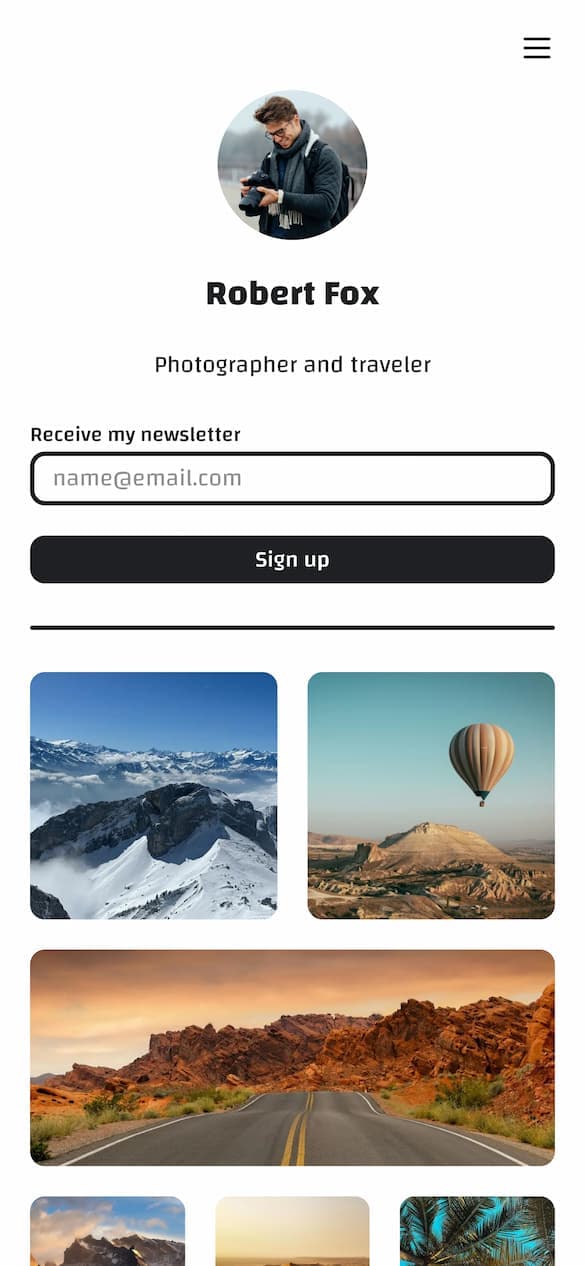
Brands and tourism boards need a clear path to reach you. A short form, a media-kit PDF gated by email, and a licensing inquiry link cover the three most common asks.
This block stays on the page year-round. It is one of the few things that does not rotate.
Block 7: Social profiles, at the bottom
Yes, link your socials. No, do not lead with them. Visitors came from social. Sending them back before they subscribe, click an affiliate, or DM you defeats the entire purpose of the page.
Build Your Page in Minutes
Drag-and-drop editor with 18 content blocks, per-block styling, and custom themes.
Create your pageSeasonal block rotation
The itinerary changes block 1 and block 2 every few days. The season changes the personality of the whole page.
Summer (June to August): beach and island destinations, festival travel, road trips. Sunglasses, camera straps, and waterproof cases spike on affiliate blocks. Newsletter pitch leans into "summer 2026 destination guides."
Winter (December to February): ski resorts, holiday travel, cold-weather city breaks. Drone and camera affiliates carry winter landscapes better than they carry summer beaches, so emphasize them. Holiday-travel gift guides drive newsletter signups.
Festival season (varies by region): Coachella, Tomorrowland, Burning Man, Glastonbury, Primavera. Event-specific bio updates, festival-gear affiliates, and pre-event city guides.
Shoulder season (spring and autumn): off-peak destinations, value-travel content, longer slow-travel trips. Newsletter pitch shifts to "how to travel when no one else is."
Plan the rotation a season ahead. The work is not heavy if you treat each season as a swap of three or four blocks, not a rebuild.
Affiliate revenue specifics for travel creators
The big six categories. Pick the two or three that fit your audience, master them, and ignore the rest until they become a real opportunity.
Hotels and accommodation
Booking.com's affiliate program, Hotels.com referrals, Airbnb's referral codes, and direct hotel-brand programs like Marriott Bonvoy or Hilton Honors. Direct-brand programs pay more per booking but require an audience that books premium properties.
Tours and experiences
Viator (owned by TripAdvisor), GetYourGuide, and Klook (the strongest in Asia). For specialist tours, direct partnerships with the operator usually pay better than the marketplaces, but the marketplaces convert higher because travelers trust them.
Gear and photography
Amazon Influencer Storefront for breadth. B&H Photo and Adorama for camera-specific links. REI and Patagonia for outdoor. DJI's affiliate program for drones. Skyroam, Wise, and Revolut for travel-finance products that pay well per signup.
Credit cards and finance
High-value, low-volume. Chase Sapphire, Capital One Venture, Amex Platinum pay a meaningful commission per approval. Disclose clearly, follow FTC guidance, and do not lead with credit-card affiliate placement unless your audience is squarely in that demographic.
VPNs and travel apps
Recurring commissions are the play. NordVPN, ExpressVPN, and Surfshark all pay recurring percentages. Travel apps like Wise and Revolut pay per signup, and the conversion is strong because most international travelers genuinely need them.
Tourism boards and DMOs
Underused. Many regional tourism boards pay creators per qualified click, per booking, or as a flat campaign fee. They rarely show up on affiliate-network search because they are negotiated directly. Pitch when you are planning a trip to their region.
A note on disclosure: every affiliate block needs a clear FTC disclosure visible on the page. "I earn a small commission on some links" works fine. Hidden affiliates kill audience trust faster than any algorithm change.
Email-list capture for travel creators
The single highest-leverage block on the page. Treat it like a real product, not a checkbox.
Lead magnets that work: a city packing list, a photographer's location guide for a specific destination, behind-the-scenes notes from a recent trip, a budget breakdown of a popular route.
Welcome sequence: three to five emails introducing your travel style, your favorite destinations, your gear philosophy, and what subscribers can expect (and how often).
Per-destination newsletter pitch: "Subscribers get my [next destination] guide before it goes on YouTube." This converts because it makes the value concrete and time-bound. Generic "join my newsletter" pitches convert worse than the platform default.
Custom domain for travel creators
If you have any intention of working with brands, tourism boards, or magazines, a custom domain on your bio link is not optional. yourname.com, yourname.travel, or yourname.link all work.
A custom domain does three things at once: it signals seriousness to brand contacts, it makes your URL bookmarkable, and it protects you from a platform you do not control changing the rules of the road. The cost is a domain renewal once a year. Plenty of bio-link tools, including Linkero, include the domain mapping in the core feature set. Read more on the link in bio custom domain setup.
Comparing tools for travel-creator use
The features that matter for travel creators are a narrower slice of the general bio-link feature matrix. Rotation, analytics by source, affiliate-friendly blocks, custom domain, and a media-kit-friendly visual treatment.
| Feature | Linkero | Linktree | Beacons | Bio.Sites by Squarespace |
|---|---|---|---|---|
| Block rotation per itinerary | ✅ | manual reorder only | manual reorder only | manual reorder only |
| Stripe block for direct sales | ✅ | ❌ | ✅ | ❌ |
| Affiliate-link blocks with analytics | ✅ | basic | ✅ | basic |
| Analytics by referral source | ✅ | ✅ | ✅ | limited |
| Custom domain | ✅ | paid tier | paid tier | Squarespace plan |
| Image gallery for destination photos | ✅ | image grid | ✅ | ✅ |
| Media-kit visual customization | per-block styling | templates | templates | templates |
Linktree
The default-recognition option. Works fine as a static link list. The 2025 Sticker Bio Boards launch added visual customization but did not solve the rotation problem, which is the one problem travel creators most need solved.
Bio.Sites by Squarespace
Clean templates, strong visual storytelling, and a sensible fit if you already live inside the Squarespace ecosystem. Less affiliate-revenue tooling than Beacons or Linkero. See the bio.sites by Squarespace review for the full breakdown.
Beacons
All-in-one creator platform. Built-in store, email tool, and media kit. Watch the transaction fees on free and mid-tier plans, especially if you are running gear sales through the store rather than affiliate links.
Linkero
Block rotation, Stripe blocks for direct sales (presets, photo licensing), affiliate-link blocks with per-block analytics, custom domain, and analytics by referral source so you can see whether Instagram, TikTok, or YouTube actually drives your bio-link traffic. Visual customization runs per-block so the page can match your travel brand without locking you into a template. See current pricing for plan details.
For a head-to-head of the broader category, the best link in bio tools roundup covers the full field, and the musician release-week bio link playbook is worth a read if you want to see how the rotation pattern works for a different creator niche.
Real travel-creator patterns that work
A few common shapes the high-performing pages settle into:
Pattern A: current trip + newsletter + gear. The simplest version. "Currently in [city]" on top, latest destination guide second, newsletter third, gear affiliates fourth. Everything else lives below.
Pattern B: seasonal rotation. Summer beach setup swaps to winter ski setup swaps to festival setup. Three template configurations the creator switches between, plus the rotating "currently in" block.
Pattern C: destination archive front page. "Recent destinations: [list]" at the top, with each entry deep-linking to its own guide. Works for creators with a strong content library. Treats the bio link as a mini-portfolio rather than a "what am I doing right now" page.
Common travel-creator bio-link mistakes
- Static link list that has not been updated in six months.
- 15 affiliate links competing with each other. Pick the 3 to 5 that matter for the current trip.
- No email capture anywhere on the page.
- Hiding the latest content below sponsor placements.
- Stock photography on a travel-creator page. Use your actual photos. The credibility delta is enormous.
- No clear path for brands to reach you. Sponsorship inquiry plus media kit is the minimum.
- Affiliate disclosure missing or buried. The FTC fines this. The audience trust loss is worse than the fine.
FAQ
What should travel bloggers put in their link in bio?
A current-destination block, your latest destination guide, an email signup, three to five affiliate-gear picks relevant to the current trip, a sponsorship-inquiry block, and social profiles last. Skip generic link lists with everything mixed together.
What is the best link in bio for travel content creators?
The tool matters less than the structure. Pick a tool that supports block rotation, custom domain, and analytics by referral source. Linkero handles all three on the Pro plan. Linktree and Bio.Sites both work if your audience is small and the page does not change much.
How do travel creators monetize their link in bio?
Three layers stacked: affiliate links to gear, hotels, tours, and travel finance; direct sales blocks for presets, photo licensing, or coaching; and an email list that drives future bookings and brand-deal leverage. Most creators lean too heavily on affiliates and underuse the email list.
How do I rotate my bio link for different destinations?
Update the top one or two blocks at every new destination: the "currently in [city]" block and the latest destination guide. Refresh affiliate picks if the destination changes the relevant gear category. Leave the bottom of the page (sponsorship inquiry, social links) alone.
What affiliate programs work best for travel creators?
Booking.com for hotels, Viator and GetYourGuide for tours, Amazon Influencer for gear breadth, B&H for camera gear, NordVPN for recurring commissions, and direct partnerships with tourism boards for the destinations you cover most. Recurring-commission affiliates beat one-time payouts over time.
Should travel creators use Linktree or alternatives?
Linktree works as a static link list. If you want rotation, deeper affiliate-block analytics, or per-block visual styling that matches your brand, alternatives like Linkero or Beacons fit better. Compare on the specific features your travel workflow needs.
How do I add multiple destinations to my bio link page?
Use a destination-archive layout (Pattern C above): a single block lists your most recent destinations, each linking to its own guide. Or use the rotation pattern (Patterns A and B): show only the current destination prominently, and let the archive live on your blog or YouTube channel.
The bottom line
A travel-creator bio link is not a link list. It is a small landing page that updates with your itinerary, stacks the right affiliate programs for the current trip, captures the email addresses of people who genuinely want your next destination guide, and gives brands a clean way to contact you.
Build it once with the seven-block pattern above. Update the top blocks at every destination. Rotate the affiliate stack with the season. Treat the email signup like a real product, not a checkbox. The bio link becomes a quietly compounding asset that works while you are on a 14-hour bus to the next stop.
Build Your Page in Minutes
Drag-and-drop editor with 18 content blocks, per-block styling, and custom themes.
Create your page